Kinetic Energy Harvesters (KEH)

kinetic energy harvester graph

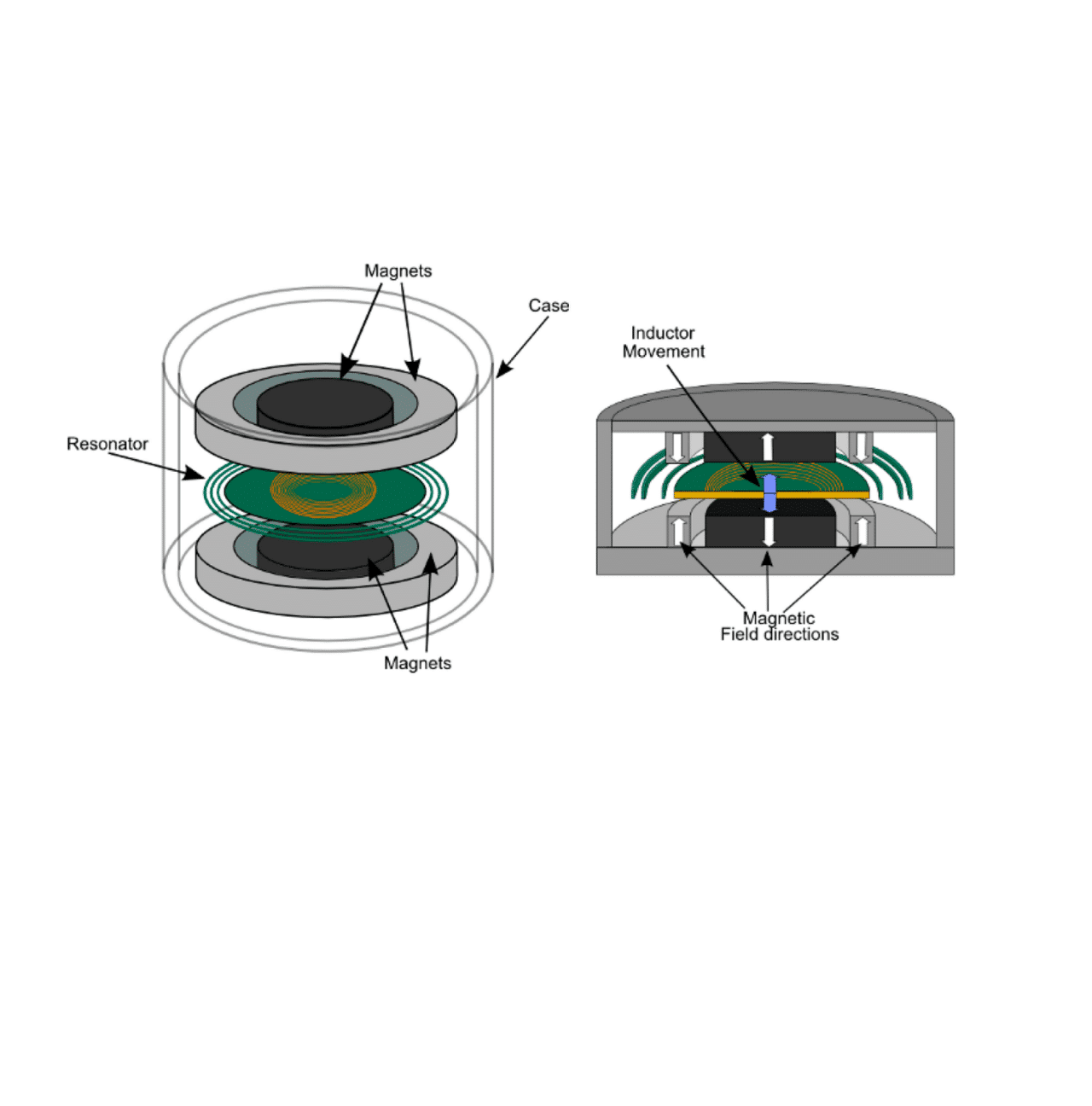
Kinetic or electrodynamic harvesters convert movement or vibration energy into electrical energy based on Faraday’s law of induction by moving a coil through a permanent magnetic field. A very well-known application making use of this principle is the pickup element of a record player.

More and more companies offer IoT devices based on this energy harvester principle, e.g.,

Revibe which offers IoT sensors for railway and mining which are self-powered over its entire operational lifetime, so no batteries have to be replaced. (https://revibeenergy.com)

Enocean which offers a switch to control, e.g., your indoor light. Just pressing the switch gives enough energy to send a couple of bytes to a receiver to switch a device on or off. (https://www.enocean.com/en/)

Enervibe which offers energy harvesters for smart tyres scavenging up to 30mW depending on the vehicle speed. Based on this energy harvester they offer a self-powered tyre monitoring system measuring, tyre load, tyre air temp, road condition, tyre pressure, rubber wear, and speed.  Enervibe also offers a KEH-based sensor for smart shoes, eliminating the need for battery replacement. (https://enervibe.co)

Above are just a couple of examples showing the diversity of the different types of Kinetic Energy harvesters existing already today. When compared to photovoltaic, electrodynamic harvesters do not have the highest power density (the power density of machine vibration is around 800 microwatt/m3). However, it is still a very useful source of energy for powering IoT devices.

Image credit: mdpi.com
Vous pouvez aussi aimer

qualinx logo

Congratulations to Qualinx B.V. on Raising €20 Million from Dutch Investors

The TD Shepherd team is happy to congratulate the Qualinx B.V. team on successfully raising €20 million from Dutch investors. TD Shepherd has provided strategic support to Qualinx over the years (starting in 2018), witnessing each step of their journey; their growth and success, makes us truly proud of their outstanding achievements.

Lire plus
illustration showing corporate collablrations

Corporate Collaborations: Your Lifeline Through the Valley of Death

If there’s one thing we’ve learned about surviving the Valley of Death in deep tech, it’s this: don’t go it alone. This stage is all about leveraging relationships, and corporate partnerships can be your most valuable lifeline. The key is to think beyond customers.

Lire plus
Minimalist illustration of an R&D laboratory partially obscured by thick fog, with lab equipment like a microscope, test tubes, and a flask in the foreground and an ‘R&D’ building fading into the mist, symbolizing uncertainty and the early, unclear stages of deep tech development.

The Deep Tech ‘Valley of Death’

The so-called “Valley of Death” in deep tech isn’t just about running out of cash—it’s about navigating a period where expectations clash with reality. Investors want to see traction, but your tech isn’t market-ready. Customers are intrigued, but they’re not ready to commit. And your R&D costs? They’re still burning through cash like it’s a bonfire.

Lire plus