Congrats to Innatera on Their Successful Investment Round

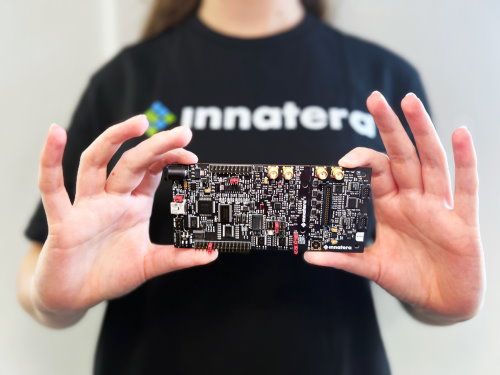
A person wearing a T-shirt that says Innatera holding up a neuromorphic processing chip

TD Shepherd is thrilled to congratulate the exceptional team at Innatera Nanosystems on the successful closing of their recent investment round, raising an impressive 15 million euros! This milestone achievement marks a significant step forward in advancing the innovative landscape of ultra-low-power neuromorphic processors.
With support from Invest-NL’s Deep Tech Fund, the EIC Fund, and existing backers MIG Capital, Matterwave Ventures, and Delft Enterprises B.V., Innatera is geared-up to accelerate its mission of revolutionizing the integration of intelligence into sensors and sensor-based devices.
Well done, Innatera!

To find out more, please visit: https://bits-chips.nl/artikel/delfts-innatera-bags-e15m-for-mass-production-of-brain-inspired-processor/
Image Credit: Innatera
Vous pouvez aussi aimer

the scheme of benefits delivered by advisors to startups

Why Many Startups Need External Expertise

Semiconductor innovation requires navigating a complex maze of high costs, lengthy development and qualification paths, detailed technical specifications, and, of course, the right market timing. For startups that seek to lead in their space, external expertise isn’t just helpful; it is almost always essential. 

Lire plus
TD Shepherd and HTVD logos

TD Shepherd Is Now a Partner at HTVD

We are excited to announce TD Shepherd as a partner of High-Tech Venture Days 2025 (HTVD25). HTVD is a matchmaking event that brings together three main groups: startups, investors (especially venture capital firms, corporate venture arms, etc.), and established companies (corporates). 

Lire plus
4k-mems-infrared-emitter

Tiny IR: Opportunities & Technical Challenges Behind

Generating infrared light isn’t difficult. But generating it on a chip — reliably, efficiently, and compactly — is a different story. Traditional IR sources rely on heating elements. They radiate across a wide range of wavelengths, consume significant power, and require filters to isolate the signals. Manageable in labs, unworkable in wearables.

Lire plus