TD Shepherd Interview With EE Times | Europe

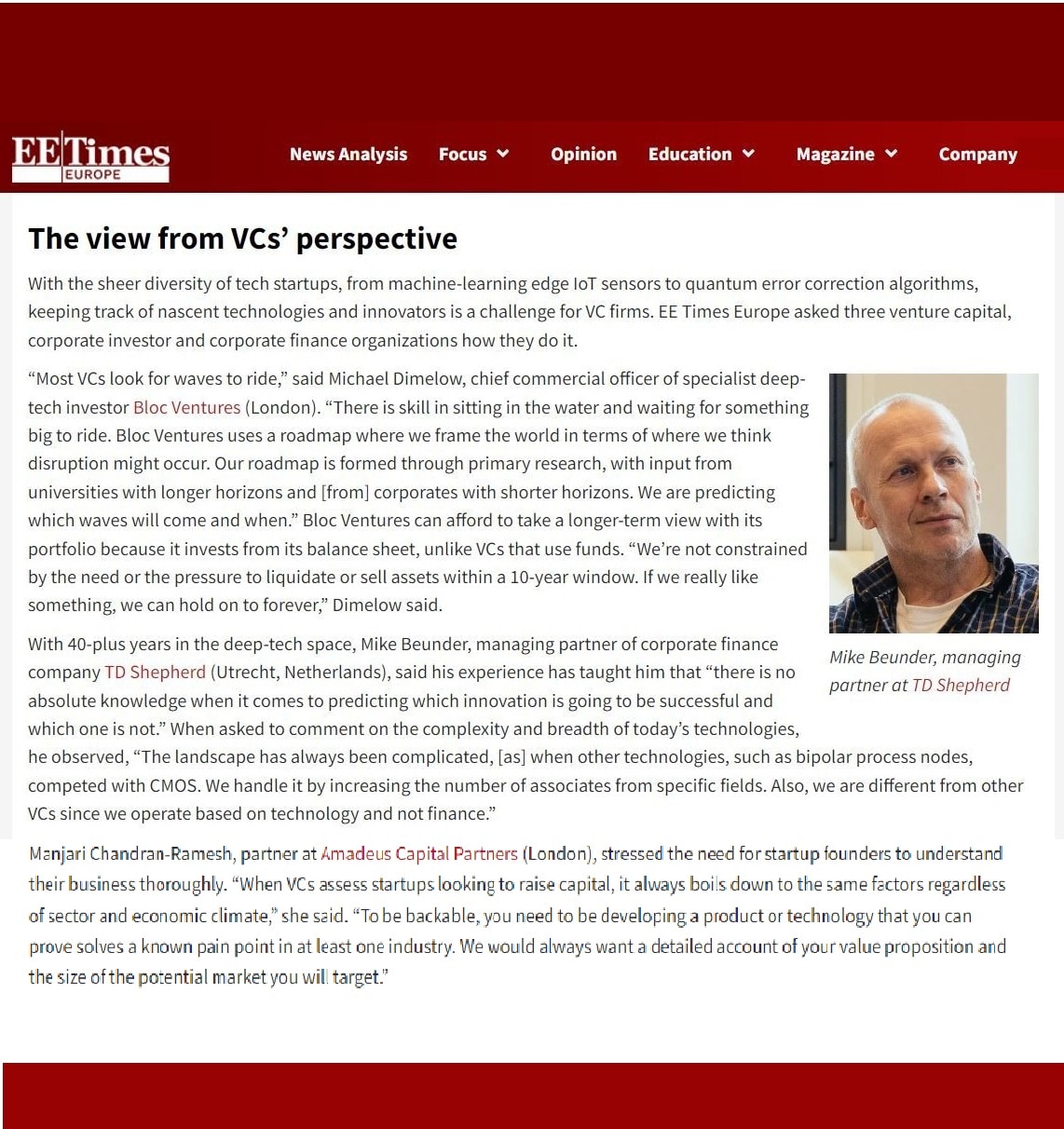
A screenshot of article

“There is no absolute knowledge when it comes to predicting which innovation is going to be successful and which one is not” – Mike Beunder, Managing Partner of the corporate finance company TD Shepherd & Co. B.V. (Utrecht, Netherlands), during his interview with Robert Huntley, MIET in EE Times | Electronic Engineering Times.

EE Times | Electronic Engineering Times has recently published an insightful article titled “Venture Capital in Europe: Picking the Right Wave to Ride.” This feature includes exclusive interviews with key players in the venture capital landscape, such as Mike Beunder, Managing Partner of TD Shepherd; Manjari Chandran-Ramesh, PhD, from Amadeus Capital Partners; and Michael Dimelow from Bloc Ventures. The interviews shed light on the challenges and strategies involved in navigating the unpredictable realm of innovation.

To access the full article, visit https://www.eetimes.eu/venture-capital-in-europe-picking-the-right-wave-to-ride/
You might also like

the scheme of benefits delivered by advisors to startups

Why Many Startups Need External Expertise

Semiconductor innovation requires navigating a complex maze of high costs, lengthy development and qualification paths, detailed technical specifications, and, of course, the right market timing. For startups that seek to lead in their space, external expertise isn’t just helpful; it is almost always essential. 

Read more
TD Shepherd and HTVD logos

TD Shepherd Is Now a Partner at HTVD

We are excited to announce TD Shepherd as a partner of High-Tech Venture Days 2025 (HTVD25). HTVD is a matchmaking event that brings together three main groups: startups, investors (especially venture capital firms, corporate venture arms, etc.), and established companies (corporates). 

Read more
4k-mems-infrared-emitter

Tiny IR: Opportunities & Technical Challenges Behind

Generating infrared light isn’t difficult. But generating it on a chip — reliably, efficiently, and compactly — is a different story. Traditional IR sources rely on heating elements. They radiate across a wide range of wavelengths, consume significant power, and require filters to isolate the signals. Manageable in labs, unworkable in wearables.

Read more