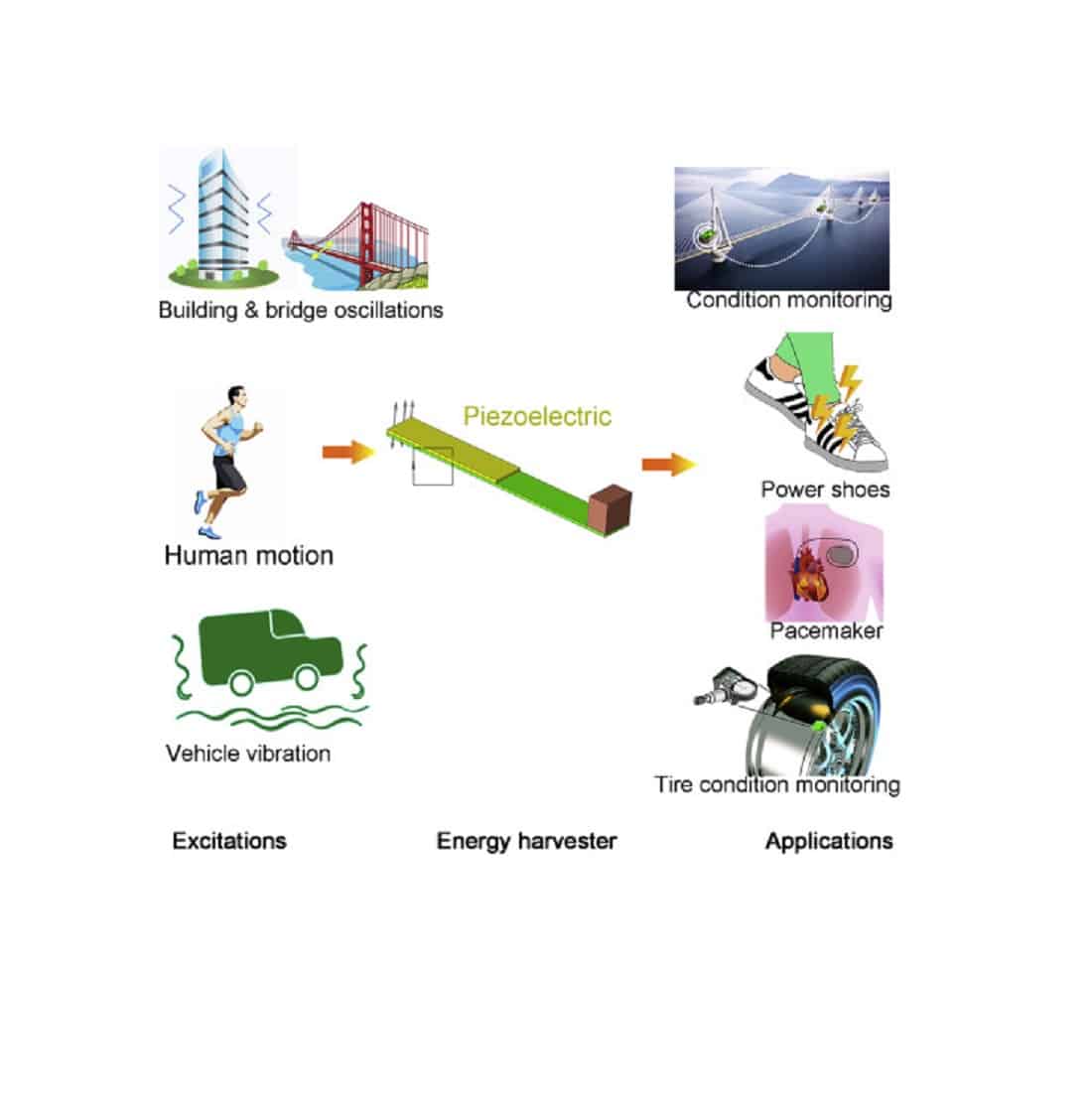
Some materials have the ability to generate an electric charge when subjected to mechanical stress. This is called the piezoelectric effect where the electric charge is accumulated in certain solid materials such as crystals and certain ceramics. This effect is utilized in many applications ranging from doorbells, cigarette lighters, and gas stove ignitors to printers and amplifiers.
It is also possible to use a piezoelectric material as a transducer to convert mechanical strain or movement into useful electric voltage or current. Such generators are often based on a cantilever beam or a membrane that oscillates at the same frequency as the vibration source. In addition, it is also possible to generate electricity by applying pressure to the material and thus harvesting energy from floor tiles, shoe soles or tire pressure monitoring.
PEH is a convenient technique for converting mechanical energy into electrical energy. Since the piezoelectric effect is based solely on the internal polarization of the used material and does not require a separate voltage source, magnetic field, or contact it can easily be applied.
PEH in combination with microelectromechanical systems (MEMS) is a very promising technique due to factors. Firstly, the ability to make the oscillating cantilevers very small and secondly, low-cost by using a semiconductor process for high volumes of production.